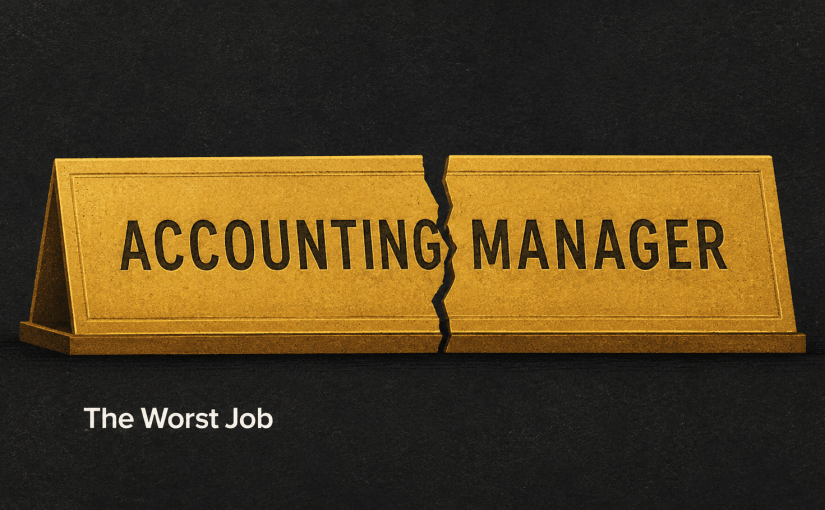
Believe it or not, becoming an accounting manager was aspirational when I started out.
Being a manager meant making more money, having more freedom and flexibility, and having real power and autonomy. There used to be a clear distinction between managers and working managers. Managers oversaw teams: onboarding, training, reviewing, and assigning work. Working managers did all of that plus carried a full load of their own deliverables.
That distinction no longer exists. Now all managers are working managers, juggling workloads sometimes heavier than their direct reports’ while also being expected to manage their teams in their downtime.
Devaluing the title destroyed what made the job aspirational.
The worst part is that we did it on purpose.
In a recent episode of the Optimist Economy podcast (recommended listen), titled “No Overtime for the Supervisor of Sandwiches,” economist Kathryn Anne Edwards discusses overtime. Midway through, my ears perked up. She puts words to something I’ve observed for years but couldn’t quite articulate.
Edwards discusses how in 2004 Congress raised the salary cap for overtime eligibility. In response, businesses did what she calls the “systematic managerial titling of workers.” To avoid paying overtime, companies took employees who had just become eligible and gave them managerial titles. Managers are exempt. Problem solved. One of the most outrageous examples: hostesses becoming Directors of First Impressions.
I am not an economist, but this clarifies so much of what I’ve seen in my career.
Early in my career, I reached a breaking point waiting for a promotion. I was ready to quit when the company’s CFO called me to his office. He argued that the problem was not the lack of a promotion, but my attachment to a title. His words: we all know what you do for this company and we value it, so what does it matter what your title is?
I looked at the nameplate on his desk. It read: Cofounder / Chief Financial Officer.
I said: so we can change that to Janitor, and you wouldn’t mind, right? I mean, we all know this company wouldn’t be what it is without you.
He paused. Then he smiled. You’re right, he said.
Titles matter. They matter to the people doing the work. They matter when you’re looking for your next opportunity. A title is one of the few data points a potential employer uses to understand the scope of what you did. And it matters on the other side too: when a candidate evaluates a role, the title is how they gauge what the job is and what fair compensation should look like.
By overusing and outright abusing managerial titles, companies broke the compass. Accounting Manager has become the single worst job in accounting.
And things are getting worse.
In recent months, recruiters keep reaching out to me about Accounting Manager and Senior Accounting Manager roles. Their opening line is always the same: this role is expected to run the entire accounting function.
They outline the responsibilities. I listen. Then I let them know that what they’re describing is a Controller, not a Manager, and I advise them to go back to their hiring team and rethink the title and the compensation package.
The title inflation that started as a way to avoid paying overtime has now become something else entirely. It’s a way to get senior-level work at mid-level prices. That’s not a broken system. That’s the system working exactly as designed.


One thought on “The Worst Job in Accounting”