The Hiring Process Was Broken Before You Found It

The hiring process is broken.

People can’t find jobs. Companies can’t find the talent they say they need. Jobs sites are full of open positions, yet no one is being hired.

Maybe it was always broken.

In What Color Is Your Parachute?, the author cites a Financial Times survey that found the hiring process was only 3% more effective at picking a good employee than random chance.

That stuck with me. Decades later, after going through hundreds of interviews and hiring dozens of people myself, I see what the problem is.

And it is everything.

Companies fail to figure out what they actually need before they start looking. They evaluate candidates against criteria that doesn’t exist, and then the role changes because it was never defined to begin with.

It all starts with the job description.

I’ve seen companies dust off an old job description even when they haven’t hired for the role in years and the role has changed materially in that time.

Recently, I interviewed at a company where it felt like they were workshopping the role as the interviews went along. I was sitting with the controller on a Zoom and asked how she envisioned this position interacting with the rest of the team. She responded that maybe they didn’t need this role after all. Maybe they were looking at things wrong. Maybe they needed to split the work along duties instead of business units.

While she was talking to herself, I was questioning why I was even in this meeting. They didn’t even know what they were interviewing for.

A week later, I got a polite email from HR closing the loop. Two days after that, I got a message from LinkedIn saying that I was a great fit for a new role at the same company.

The role wasn’t even that different. Same department, same level, a few key differences. Instead of going back to the candidates they already interviewed and asking if they would be interested in a slightly different role, they cleared the slate and started a new search.

I’m surprised that a company that seems so far behind has the time to have their employees interview candidates over and over as they figure out what they need.

A friend was telling me about a failed hire by one of his clients. The client was looking to fill a Senior Accountant role, a highly independent position. She hired a young guy who had graduated two years prior. He had gone to a great school and passed the CPA exams.

He turned out to be a terrible hire, and the company let him go before his 90-day trial period ended.

My friend was wondering what went wrong. I told him the answer was there all along. His client needed an individual contributor who could function with drive and independence. Instead, she hired a junior accountant with two years of experience in a large, highly automated company that was probably still figuring things out.

The problem was not the candidate. It was the candidate-role relationship.

Then there is the fact that the role you hire someone for often changes, sometimes shortly after the candidate starts. A candidate who could have been great at the original role might struggle with the new expectations.

I once started a job where I was told the company was “a mess” and that the team needed a lot of help. I debated whether to walk away, but I was offered a lot of autonomy and independence on how to deal with the issues. I decided to accept.

Five months passed between my first interview and my first day. That alone said a lot about the “mess.”

On my second day, the controller set up a meeting with me. I thought it was a simple welcome to the team. It wasn’t.

She told me that since we had last spoken, months prior, she had gotten approval for another hire at my level. She had just started the search but didn’t want to assign me a specific role until “all the pieces were on the board.” She asked for my patience and told me to observe and help around until my colleague was hired.

I declined politely. I told her that if there wasn’t a clear role for me, I was happy to leave. I had left a position where I was leading a team to take a role where I was going to lead a larger team, not to sit around and help like a junior staff member. If they couldn’t provide what was promised, I would leave and look for a better opportunity.

The controller quickly changed her tune and gave me a team and a somewhat defined role.

What would have happened if I had agreed to just wait?

Colleagues would have started wondering what I did. Questions about my competence would have surfaced. And I would have probably been quietly escorted out of the company while the controller wondered why this hire didn’t work out.

Roles are not well defined. Every member of the hiring committee is looking for something different. After the candidate is hired, the role morphs into something unrecognizable. And then we wonder what went wrong.

Slow, invisible systemic failures that are ultimately blamed on the hire who doesn’t stay, and that hurt the team left behind, understaffed, and starting the same failed process all over again.

Behind every resume is a person. Someone who prepared for the job interview, showed up, and trusted that the company knew what it was looking for. It would be nice if the process remembered that.

It’s Not You

Don’t worry, even with a CPA employers don’t want to hire you.

That was my reply to a LinkedIn post from an accountant struggling to find a job because employers were “obsessed” with the CPA certification. I have my CPA, so trust me, I know.

Everyone forgets one thing: market dynamics will always win against personal effort. People are not finding jobs because companies are not hiring. It is not you. It is the market.

People talk about how we are living through unprecedented times. As someone who was unemployed for almost two years during the Great Recession, I can tell you, these times are very precedented.

When I was first laid off during the Great Recession, so many people mobilized around me. Colleagues, classmates, friends, professors, academic staff. I was pursuing my MBA at the time. It was like a village sprung up around me.

Everyone was cheering me on and offering to help however they could. People would send me job postings, introduce me to contacts, and check in regularly.

After a year of unemployment, I could sense the shift.

People would ask how the job hunt was going, and when I said it wasn’t, silence would follow. I had zero interviews in year one of unemployment and three in year two.

Finally, a “friend” said the quiet part out loud: I had been unemployed for so long, I had to be the problem.

I tried to dismiss her comment, but the more I thought about it, the more I started to question myself. Was she right? What was wrong with me?

I tried to quiet that voice by pouring myself into volunteering. Maybe if people saw that I could work for free, they could eventually pay me to work.

In a culture where we base so much of our value on work, if you are not working, you are not valued. And there is so much that is out of a job hunter’s hands.

After two years, I found a job. And then found another. I was working seven days a week. I would have worked more if the week had moredays.

I didn’t change. I didn’t get an additional certification that made me more employable. I didn’t all of a sudden develop work ethic. I found a job when companies started hiring again.

A friend shared recently how she is struggling to find a job because employers keep discounting her years of experience as an entrepreneur. She built a business from scratch and wore far more hats than she ever did in her corporate jobs. Yet none of those skills are being recognized.

I joked with her that she had tasted freedom, and maybe hiring managers were afraid she had become unmanageable. Maybe only half-joked.

Hours later, I stumbled over an article written by a professional in her 50s. She was struggling to find a job too. She had cut decades of experience from her resume and removed her graduation dates, yet employers still labeled her as “too overqualified” and “too expensive.”

What do all these concerns have in common? They put the blame of unemployment on the unemployed.

A single individual cannot fight market dynamicsalone. A single individual cannot fight inflation, trade wars, wars-wars, interest rate hikes, and corporate hiring freezes alone.

So if you are hitting a wall while looking for work right now, remember what I learned the hard way. I didn’t become a better candidate. I didn’t unlock some secret. The market shifted, and the phone started ringing again.

Unfortunately, this’s not a motivational story. That’s just how it works.

Be kind to yourself. This is not your fault.

DOE (Depends on Experience)

DOE. Depends on Experience.

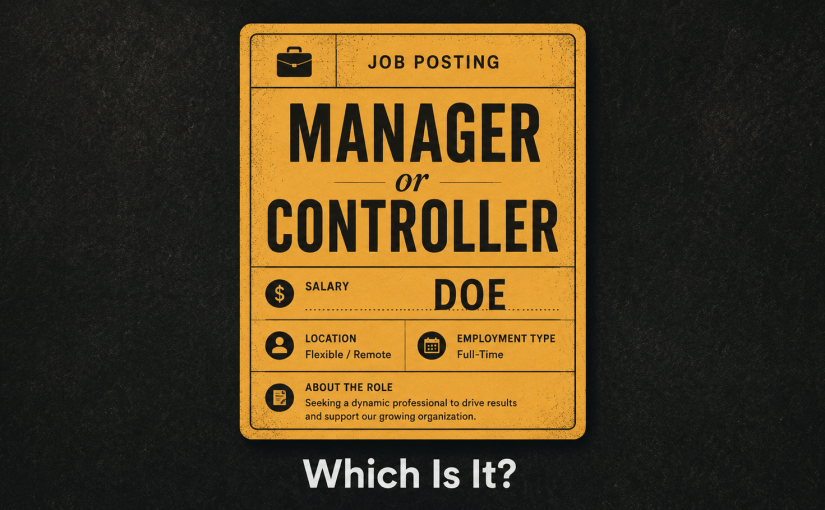
They showed up on a recruiter’s LinkedIn post advertising opportunities at an “amazing” company. Senior Accountant or Manager, DOE. Senior Accounting Manager or Controller, DOE. Salary ranges also DOE.

Why?

Title and salary should not depend on the experience of the candidate. They should depend on the nature and requirements of the job. I have discussed title inflation before, so I will try not to repeat myself.

There is a moat the size of an ocean between a Senior Accounting Manager and a Controller. So which is it? Is the role a Senior Manager job or a Controller job?

If you need a Controller, hire a Controller, and pay for a Controller. Hiring a Senior Accounting Manager and expecting them to somehow do the job of a Controller is setting both the candidate and the company up for failure.

You’ll get Senior Accounting Manager output, and everything else will fall through the cracks.

But the candidate can grow into the role, right? Someone might argue.

How? I ask.

A company that can’t tell the difference between a Senior Accounting Manager and a Controller doesn’t have the accounting leadership to develop one into the other. So who exactly is going to grow this candidate into the role?

A recruiter reached out to me the other day for a “Controller track, Accounting Manager” role.

I laughed. Where is the track?

These imaginary tracks sound less like a well-defined road and more like a self-guided tour through a forest. No map, no compass. Good luck getting to the other side.

I used to work with a woman whose title was Senior Manager, Fixed Assets. Fixed assets, for the non-accountants, are the physical assets of a company. Think equipment, land, buildings, vehicles. Things the company uses to create value.

She was six years away from retirement and wanted to hire her replacement. The role she was really hiring for was Junior Accountant.

Her pitch to new hires: work hard and in six years you can sit in my chair and have my job. She hired two young people who quit in quick succession, unimpressed with what she had to offer.

She then hired an older, and as she put it, more “mature” candidate who would have the patience to wait his turn.

I pointed out that a forty-year-old with over a decade in accounting accepting a Junior Accountant position was possibly a red flag.

She had to terminate him after a week because after five days he still had not managed to learn how to turn on his computer.

She couldn’t understand why there were no qualified takers for this great opportunity. Why weren’t more people willing to take a junior role with low pay that would eventually transition into a middle manager role with possibly still low pay?

This sounds like a joke, but it gets worse. Even that laughable opportunity didn’t actually exist.

Six years is an eternity in corporate America. The company could have been bought and sold many times over. Her department could have been outsourced to a third-party firm, which I saw happen to other teams during my tenure. Or the company could have decided to move the whole function upstream to corporate.

This was not her company, soit was not her track to promise.

It’s time to stop. Stop advertising two roles as one. Stop posting senior roles at junior prices. Stop promising career paths that don’t exist and that aren’t yours to offer.

This is the role. This is the pay. We hope you grow with us, but right now we need this job filled and we need the right person to fill it.

That’s not cold. That’s honest. And honest is what candidates deserve.

The Worst Job in Accounting

Believe it or not, becoming an accounting manager was aspirational when I started out.

Being a manager meant making more money, having more freedom and flexibility, and having real power and autonomy. There used to be a clear distinction between managers and working managers. Managers oversaw teams: onboarding, training, reviewing, and assigning work. Working managers did all of that plus carried a full load of their own deliverables.

That distinction no longer exists. Now all managers are working managers, juggling workloads sometimes heavier than their direct reports’ while also being expected to manage their teams in their downtime.

Devaluing the title destroyed what made the job aspirational.

The worst part is that we did it on purpose.

In a recent episode of the Optimist Economy podcast (recommended listen), titled “No Overtime for the Supervisor of Sandwiches,” economist Kathryn Anne Edwards discusses overtime. Midway through, my ears perked up. She puts words to something I’ve observed for years but couldn’t quite articulate.

Edwards discusses how in 2004 Congress raised the salary cap for overtime eligibility. In response, businesses did what she calls the “systematic managerial titling of workers.” To avoid paying overtime, companies took employees who had just become eligible and gave them managerial titles. Managers are exempt. Problem solved. One of the most outrageous examples: hostesses becoming Directors of First Impressions.

I am not an economist, but this clarifies so much of what I’ve seen in my career.

Early in my career, I reached a breaking point waiting for a promotion. I was ready to quit when the company’s CFO called me to his office. He argued that the problem was not the lack of a promotion, but my attachment to a title. His words: we all know what you do for this company and we value it, so what does it matter what your title is?

I looked at the nameplate on his desk. It read: Cofounder / Chief Financial Officer.

I said: so we can change that to Janitor, and you wouldn’t mind, right? I mean, we all know this company wouldn’t be what it is without you.

He paused. Then he smiled. You’re right, he said.

Titles matter. They matter to the people doing the work. They matter when you’re looking for your next opportunity. A title is one of the few data points a potential employer uses to understand the scope of what you did. And it matters on the other side too: when a candidate evaluates a role, the title is how they gauge what the job is and what fair compensation should look like.

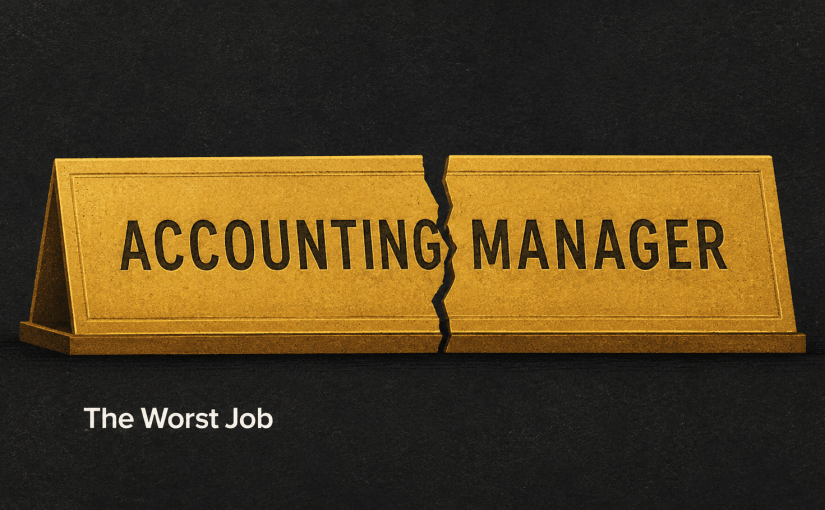
By overusing and outright abusing managerial titles, companies broke the compass. Accounting Manager has become the single worst job in accounting.

And things are getting worse.

In recent months, recruiters keep reaching out to me about Accounting Manager and Senior Accounting Manager roles. Their opening line is always the same: this role is expected to run the entire accounting function.

They outline the responsibilities. I listen. Then I let them know that what they’re describing is a Controller, not a Manager, and I advise them to go back to their hiring team and rethink the title and the compensation package.

The title inflation that started as a way to avoid paying overtime has now become something else entirely. It’s a way to get senior-level work at mid-level prices. That’s not a broken system. That’s the system working exactly as designed.

Impossible Questions

I knew better, but I did it anyway. I clicked on a clickbait article about hiring red flags.

Some of the advice was basic. Never hire someone who badmouths their former employer. Never hire someone who asks no questions. Never hire someone who doesn’t show curiosity about the company or the role. Fair enough.

But there was one that didn’t sit well with me. The author argued that you should never hire someone who can’t answer the question: “Tell me about your biggest failure.”

The argument was that someone who couldn’t answer this question didn’t have enough self-awareness to be a good performer.

I disagree.

Not because this is untrue, but because this is what I call an impossible question.

If you answer truthfully, you are highlighting your shortcomings to the hiring manager. And you don’t know what that manager considers a disqualifier. You try something relatively safe, only to find out you’re sitting across from someone who sees that particular issue as unforgivable.

If on the other hand you try to be strategic and answer with a non-answer, or a strength disguised as a weakness, you look disingenuous. Your application moves to the rejection pile.

Heads you lose, tails you also lose.

People know what their biggest failures are. They probably lie awake at night reliving every moment. They just won’t tell you. It’s not a lack of self-awareness. It’s self-preservation.

“What is your biggest weakness” is another question in this category. It gets asked less and less these days because people have realized it doesn’t tell you anything about a candidate’s ability; other than their storytelling and spin abilities.

By asking impossible questions, interviewers aren’t being clever or fishing for red flags. They are setting people up for failure.

And the interview process doesn’t need more help at being terrible. It’s already broken and getting worse by the minute, with algorithms removing qualified candidates automatically and recruiters who can’t be bothered to close the loop after taking up someone’s time for weeks.

As interviewers, we can do better. Ask what the candidate has built. Ask how they think through problems. Ask what they would do in the first 90 days. Those questions tell you something real.

Or better yet, ask them to ask you questions. See how they think and what they care about. That will tell you more in five minutes than any rehearsed failure story ever will.