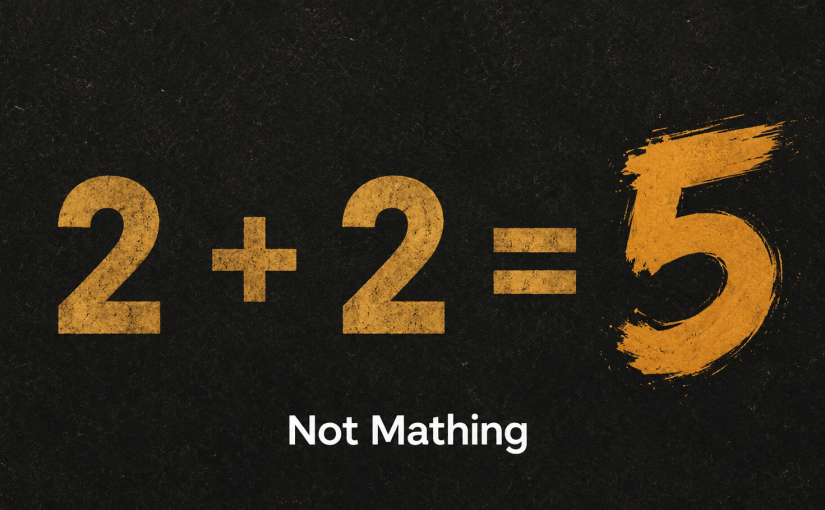
The Math is Not Mathing

Accounting Manager is the single worst job in accounting.

That was my comment on someone else’s LinkedIn post about what Accounting Managers do. It received thousands of impressions. Apparently, I’m not alone in my belief.

What I didn’t say in that comment is why. Not just why the job is bad, but why it matters. Because the damage isn’t limited to the people in the role. It reaches everyone around them.

There is a concept in organizational development called the Leadership Pipeline. The idea is simple: manager roles are linchpin positions. Without them, organizations can’t sustain themselves long-term.

The literature is clear that the most difficult career transition is the one from Managing the Self to Managing Others. The people who get promoted are the ones with the strongest technical skills. The ones with the interpersonal and relationship skills needed to succeed as a manager get left behind. What makes you good at the first job is not what makes you good at the next one.

Still, this is not an insurmountable obstacle. Training can go a long way.

But of course, that’s where the real failure happens.

I remember being a first-time manager and having my Director reprimand me for scheduling too many training sessions with my team. They should know, she would say. My response: how? Who taught them?

She didn’t have an answer because there wasn’t one. Nobody had taught them. Nobody had taught me either. The company expected people to become managers overnight and then blamed them when they struggled. The training budget was zero. The patience was less than that.

A less experienced person would have taken that feedback and stopped the sessions. I doubled down.

But most new managers don’t push back. They absorb the message: training is a waste of time, your team should already know, figure it out. And then they spend the next several years managing by instinct instead of by skill, burning out, and wondering why the job feels impossible.

Over the years, I’ve had friends take steps back in their careers because they didn’t want to ‘babysit’ a team. I’ve never liked that comparison, but I understand where it comes from. When you’re given a team with no training on how to lead them, managing starts to feel like supervising instead of leading.

But here’s what people miss: the team feels it too. Nobody wants to be managed by someone who is clearly overwhelmed, clearly untrained, and clearly just trying to survive until the next close. Reports can tell the difference between a leader who is developing them and a manager who is just keeping track of them. When both sides feel like the relationship is broken, it transforms from a people problem to a design problem.

And the math confirms it. The increase in pay from individual contributor to manager is rarely proportional to the increase in stress and responsibility. You take on twice the workload, lose your overtime eligibility, become accountable for other people’s output, and get a raise that barely covers the difference. The math is not mathing.

This is the first consequence that people feel in their careers, long before the pipeline runs dry. The job stops being worth it.

And young people have noticed.

A little more than a year ago, I was having lunch with a group of junior and staff accountants  from another team. The conversation turned to the career ladder, and every single young person at the table said they didn’t want to ever become managers.

They saw their own manager and thought: too much work for not enough money.

Gen Z is choosing to stay in individual contributor roles. The more entrepreneurial ones are pursuing side hustles and their own path. The famous 5-9 after their 9-5.

They are not wrong.

The real question is what happens 10 years from now when there isn’t a pipeline of experienced managers who know how to build and lead a team. What happens when we forget how to get things done through others? What awaits us when the institutional knowledge of how to develop people, run a close with a team of varying skill levels, and turn a group of individuals into a functioning unit has simply disappeared because nobody wanted the job?

The optimist in me thinks that when faced with that crisis, companies will finally invest in real managerial training and build compensation structures that make the role worth taking.

The pessimist in me looks at current leadership, at how they’re letting things deteriorate in real time, and thinks that by the time anyone notices the pipeline is empty, it will already be too late to fill it. And when that happens, we won’t just be missing managers. We’ll be missing the people who know how to fix the problem.

That’s Why You Hired Me

Another CEO declares middle management dead. Flat organizations are hailed as a corporate utopia full of efficiencies and cost savings.

I understand why this dream appeals to people who have survived bad middle managers. But as someone who has been a middle manager, I can confidently say that middle managers are the heart of most organizations.

They operationalize the vision of leadership.

VPs and other C-suite executives come up with dazzling ideas. It is up to the middle managers to make them a reality. No VP that I know will sit with a team to make the small go/no-go decisions. Whether a variance is worth flagging or just noise, how to code a transaction that spans two entities, which reconciling items to escalate and which to resolve on the spot. These might seem like small decisions, but they are the decisions that can paralyze a team and stop progress.

I remember one occasion when I received a request from corporate. They wanted my team to document some processes. I had a team of four, and each one had a task or two to document. I sent the team the request from corporate and asked them to start working on it as soon as close was over. I sent two separate reminders, yet I grew concerned when no one reached out with questions. In my book, no questions mean no work.

A few days before the deadline, I set up an in-office 20-minute meeting to go over the progress and answer any questions. My boss pushed back. He said: why do you need a meeting? You sent clear instructions. This is a no-brainer. I said: just trust me.

At the meeting we found out that no one had even started working on the project. I was proven right.

One person didn’t even know there was a project to work on. He asked if he was cc’d on the emails. He was. The second one received the emails but didn’t think they applied to him. His thought: if I had to do something, someone would tell me in person. The third one knew about the project but somehow confused the deadline date with the date he was supposed to start. The fourth one understood the assignment but had not done anything about it… yet.

After the meeting my boss asked me to stay behind. His exact words were: what the f* was that? He couldn’t understand how this group of people had not understood the assignment.

I responded: that’s why you hired me.

Someone might respond to this story with: you just had a bad team. Hire better people. To that I say: I hired the best team I could afford.

Good talent is expensive, and most companies are not willing to write a blank check. But even if your company is willing to pay top dollar to hire self-directed talent, where do you think that talent came from? The best professionals I know had great middle managers showing them the ropes for years. Giving them feedback and helping them along the way.

Leaders are built, not born.

A friend of mine started at the bottom and retired from the C-suite. At 65, she still credits her first two bosses for the trajectory.

So you’re a deep-pocketed company that decided to outsource the development of its people to other companies and only hire the best and brightest. I ask you: how long before the best and brightest get tired of self-directing and going above and beyond without any room to grow?

Imagine you have a team member who takes it upon themselves to onboard new hires and resolve ambiguity for the group. This person is already doing the work of a middle manager. They’re just not being paid for it, titled for it, or given anywhere to go because of it. How long before they figure that out? The distance between an individual contributor and the C-suite is too wide to cross without steps in between. Unless you have a top-notch internal leadership program that can bridge that gap, your best people will leave to get the growth they can’t get at your company.

I met someone recently whose company had removed all middle managers. He proudly said that it had been a year without any measurable loss of productivity. And I believe him.

But what will your productivity be in three to five years?

I do believe that if you have a strong team, probably built by a strong middle manager, where everyone knows what they do and there is cohesion, you can remove that middle manager without much change. At first.

Things start to shift once the team changes. People leave. People get hired. The strategy changes. But someone has to handle the next new executive ask.

That’s when the team starts to suffer. That’s when the bottom line suffers. That’s when you feel the absence of the middle manager. Another CEO can declare them dead. But they’re the ones keeping the company alive.