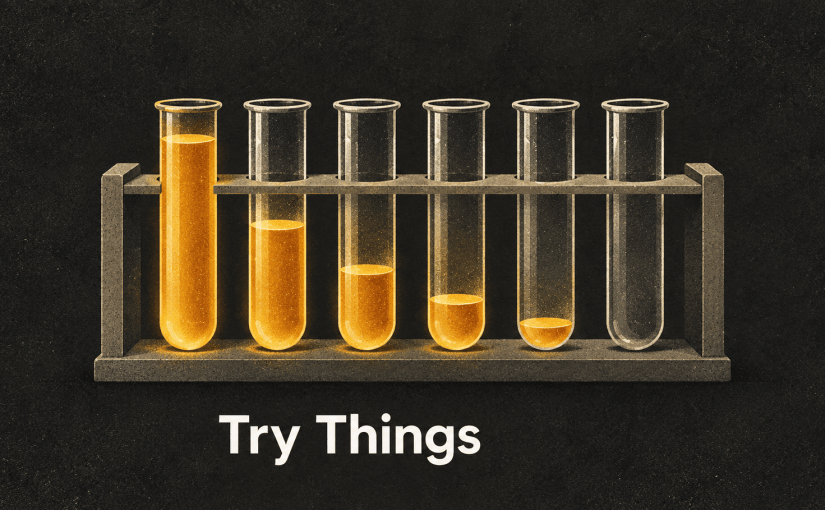
We’ve all heard it: Set a clear goal. Excel at it. Win at life. That’s the conventional wisdom about how to build a career. But is it the only way?
Tiny Experiments by Anne-Laure Le Cunff turns all of it upside down.
Halfway through the book, I was already adding to cart and sending copies to several friends and family members.
Le Cunff advises living life like a scientist. Come up with a hypothesis, develop experiments, gather data, and decide if your hypothesis has been proved or disproved. Rinse and repeat.
Instead of being paralyzed by waiting to make just the optimal decision, the book encourages the reader to go ahead and try things, one tiny step at a time.
Instead of goal setting, the author advocates for pacts. In a pact, you commit to try something new for a period of time, focusing not on outcomes but on outputs.
When I started writing this blog, I unknowingly signed up for my own pact. I promised myself to write a post every week for 52 weeks straight without expectations.
I’m almost halfway, and I’ve already learned so much. Like that I sound a lot smarter in my head, and that distilling complex thoughts into a cohesive narrative is a lot harder than anticipated. Yet it is helping me become better at making and defending my points and communicating with others.
Le Cunff writes: “urging people to find their passion may lead them to put all their eggs in one basket but then to drop that basket when it becomes difficult to carry.”
“Follow your passion” is such a toxic phrase. I know because I fell for it.
When you ask people to identify a passion, it is usually something cool or in the arts. Movies, TV, fashion, design, sports. That was me. I studied film in college because I liked movies.
It took me a whole semester to realize that sets were crazy, unorganized places. And then it took me years to realize that what I really wanted was to work in an air-conditioned office.
The real issue is that passion gives people the idea that your path should be easy and fun all the time. But nothing worth doing is ever easy.
Even if you love what you do, there will be bad days. Days full of pointless meetings and frustrations. That doesn’t mean you should quit.
Becoming an expert at anything requires mountains of effort for long stretches of time. Giving up once it gets hard means you will more than likely quit right before you become good.
I’ve always believed that you can’t be excellent at everything. Instead, you should strategically focus on what is important now and let the rest be. The book has a name for this: “strategic mediocrity.”
I have always just called it “good enough.”
I follow this principle in my personal and professional life.
At home, I choose to be nice to myself and cut myself some slack when I can’t cook nutritious meals those weeks when I’m working late for close.
At work, I always ask: what is a priority now? When I hear “everything,” I always push back. When everything is a priority, nothing is.
I’ve always taken notes during the day. What interests me. What challenges me. What catches my eye and makes me think. The book calls this practice “field notes.” Insights from the everyday.
This is not journaling. It’s rawer and in the moment. Documenting our thoughts and feelings before we put them through the filter of analysis.
The book encourages the reader to follow their curiosity, try things, take notes along the way, learn, fail, and try again. Unknowingly, I’ve been doing this for most of my career. I think it is working.

