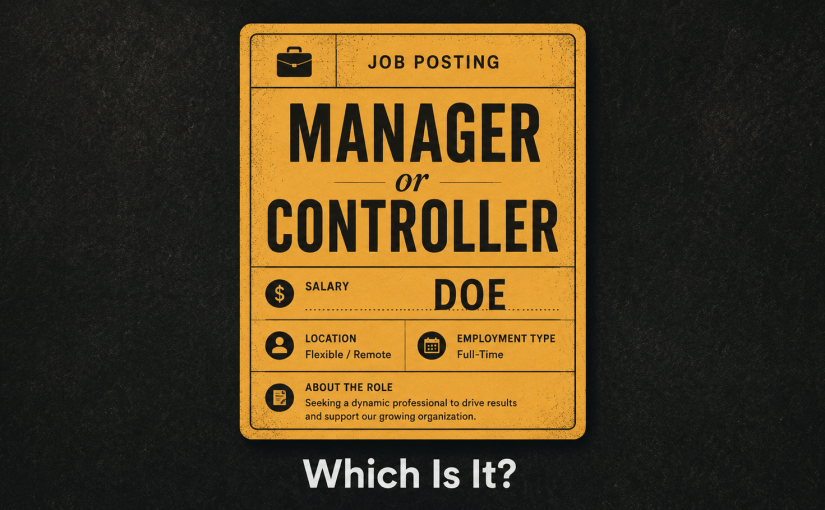
DOE. Depends on Experience.
They showed up on a recruiter’s LinkedIn post advertising opportunities at an “amazing” company. Senior Accountant or Manager, DOE. Senior Accounting Manager or Controller, DOE. Salary ranges also DOE.
Why?
Title and salary should not depend on the experience of the candidate. They should depend on the nature and requirements of the job. I have discussed title inflation before, so I will try not to repeat myself.
There is a moat the size of an ocean between a Senior Accounting Manager and a Controller. So which is it? Is the role a Senior Manager job or a Controller job?
If you need a Controller, hire a Controller, and pay for a Controller. Hiring a Senior Accounting Manager and expecting them to somehow do the job of a Controller is setting both the candidate and the company up for failure.
You’ll get Senior Accounting Manager output, and everything else will fall through the cracks.
But the candidate can grow into the role, right? Someone might argue.
How? I ask.
A company that can’t tell the difference between a Senior Accounting Manager and a Controller doesn’t have the accounting leadership to develop one into the other. So who exactly is going to grow this candidate into the role?
A recruiter reached out to me the other day for a “Controller track, Accounting Manager” role.
I laughed. Where is the track?
These imaginary tracks sound less like a well-defined road and more like a self-guided tour through a forest. No map, no compass. Good luck getting to the other side.
I used to work with a woman whose title was Senior Manager, Fixed Assets. Fixed assets, for the non-accountants, are the physical assets of a company. Think equipment, land, buildings, vehicles. Things the company uses to create value.
She was six years away from retirement and wanted to hire her replacement. The role she was really hiring for was Junior Accountant.
Her pitch to new hires: work hard and in six years you can sit in my chair and have my job. She hired two young people who quit in quick succession, unimpressed with what she had to offer.
She then hired an older, and as she put it, more “mature” candidate who would have the patience to wait his turn.
I pointed out that a forty-year-old with over a decade in accounting accepting a Junior Accountant position was possibly a red flag.
She had to terminate him after a week because after five days he still had not managed to learn how to turn on his computer.
She couldn’t understand why there were no qualified takers for this great opportunity. Why weren’t more people willing to take a junior role with low pay that would eventually transition into a middle manager role with possibly still low pay?
This sounds like a joke, but it gets worse. Even that laughable opportunity didn’t actually exist.
Six years is an eternity in corporate America. The company could have been bought and sold many times over. Her department could have been outsourced to a third-party firm, which I saw happen to other teams during my tenure. Or the company could have decided to move the whole function upstream to corporate.
This was not her company, soit was not her track to promise.
It’s time to stop. Stop advertising two roles as one. Stop posting senior roles at junior prices. Stop promising career paths that don’t exist and that aren’t yours to offer.
This is the role. This is the pay. We hope you grow with us, but right now we need this job filled and we need the right person to fill it.
That’s not cold. That’s honest. And honest is what candidates deserve.
 Real Thoughts